9 Volt Battery for Smoke Alarms Kidde
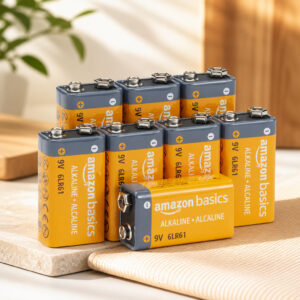
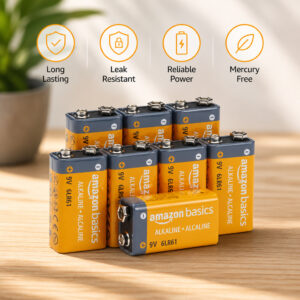
Not all Kidde smoke alarms use a replaceable 9V battery, but a lot of them do. This 8-pack is marketed for smoke detectors and comes with single-use 9V alkaline batteries (6LR61). Kidde spells out which battery each model takes, so check your manual before you fit one.
This page contains affiliate links. We may earn a commission if you buy through them, at no extra cost to you.
Will This Battery Work in Your Kidde Alarm?
Kidde sets the approved battery for each alarm model. Some models take a replaceable 9V battery, some take AA batteries, and some have a sealed 10-year battery. Run this quick check before you buy.
Kidde’s manuals name the batteries to use. The i12060A manual lists Energizer 522 and Duracell MN1604 or MX1604, for example, and does not name this brand. Check your own manual, or ask Kidde, before using it. Some customer reviews on the product listing also report a tight fit in rigid battery holders, including some smoke detectors. Never force the carrier shut.
Amazon Basics 9V Alkaline Specifications
| Property | Detail |
|---|---|
| Brand / model | Amazon Basics 9V Alkaline, model 6LR61-8PK |
| ASIN | B00MH4QM1S |
| Pack size | 8 batteries |
| Chemistry | Alkaline, single-use (not rechargeable) |
| Nominal voltage | 9 V |
| Battery code | 6LR61 (standard 9V alkaline) |
| Listed capacity | 550 mAh (test conditions not published) |
| Listed dimensions | 4.85 × 2.65 × 1.75 cm (about 1.91 × 1.04 × 0.69 in) |
| Listed weight | 45 g (Canadian listing) |
| Shelf life claim | 5 years in storage (not in-device runtime) |
| Leakage claim | “5-year leak-free shelf life” per the product listing |
| Not published | Discharge current, operating temperature, internal resistance, self-discharge rate |
Values come from the product listing and are not independently tested. Capacity depends on load, temperature and the device cutoff voltage, and the listing gives no runtime figure for any Kidde alarm.
Kidde 9V Battery Replacement Difficulty
For most people this is an easy job. An unlocked front-loading compartment is the simplest case, because the carrier usually opens without taking the alarm off the ceiling. Choosing a battery your model allows is the part that needs the most care. Tap a slice to highlight it.
- 20% Opening the compartment or lock
- 15% Swapping the battery
- 45% Choosing a suitable battery
- 20% Testing the alarm
Difficulty depends on the alarm design. A rear-loading alarm is a little harder because you twist it off its bracket first. A tamper-locked carrier can mean removing the alarm to release the lock. A hardwired alarm adds a power connector, and Kidde’s reset steps start with switching off the circuit breaker. A sealed 10-year alarm has no replaceable battery, which means there is no battery swap to do.
Difficulty score and effort split are an editorial estimate based on the steps in Kidde’s instructions, not an official rating. No standard completion time is published.
How to Replace a Kidde Smoke Alarm Battery
Tap each step to tick it off as you go. Your model’s manual always takes priority over this general guide.
- 1Check the model and battery listRead the label on the alarm. Confirm it takes a replaceable 9V battery and see which batteries the manual specifies.
- 2Release the battery lock if it is engagedIf the tamper-resistant lock is on, take the alarm off its bracket and release the lock as your manual shows. For a hardwired alarm, switch off its circuit breaker before you unplug it.
- 3Open the battery carrierOn front-loading models, press and release the carrier. On rear-loading models, twist the alarm off its bracket and open the compartment.
- 4Swap the batteryTake out the old 9V battery and fit the new one so the positive and negative terminals match the markings.
- 5Close the carrierPress it shut until it locks. The Kidde i9070 manual says a missing or incorrectly installed battery prevents the carrier closing. Do not force it on any model.
- 6Test the alarmPress and hold the Test/Hush button for at least five seconds, as Kidde advises. The horn is loud.
Recheck that the battery is seated the right way round and the carrier is fully shut. Kidde’s reset for a battery-only alarm is to remove the battery, hold the test button for at least 15 seconds, then refit the battery. Hardwired alarms need extra power steps, which your manual covers.
Other Devices That Use a 9V Battery
The product listing names smoke detectors, radios, toys, garage door openers, weather radios and flashlights. Other retailers’ 9V product pages add the remaining examples below. Confirm the battery type in your device manual first.
- Smoke alarmsCheck your model’s list
- Hardwired alarm backupMains alarms with a 9V backup
- RadiosPortable & clock radios
- Weather radiosEmergency use
- ToysIncluding remote-control cars
- Garage door openersRemotes that take 9V
- DoorbellsModels that take 9V
- FlashlightsEmergency use
- MultimetersTest & measuring
- Guitar pedalsEffects units
- MicrophonesCheck your manual
Safety, Storage & Disposal
The two posts on a 9V battery sit close together. If a metal object touches both, it can short-circuit the battery and produce enough heat to start a fire. Never carry or store loose 9V batteries with coins, keys or other metal.
- Keep new batteries in their original packaging until you need them.
- Cover the terminals of loose or used 9V batteries with tape.
- Do not recharge this battery, because it is single-use.
- Take used batteries to a local collection point and follow local rules.
9V Battery for Kidde Smoke Alarms: FAQ
Can I use this 9V battery in a Kidde smoke alarm?
The battery is marketed for smoke detectors, but Kidde sets the approved batteries model by model. The Kidde i12060A manual names specific batteries and does not list this brand, so check your own manual or ask Kidde first.
Do all Kidde smoke alarms use a 9V battery?
No. Kidde makes alarms with replaceable 9V batteries, replaceable AA batteries and sealed 10-year batteries. Check the model label before buying.
Is this battery rechargeable?
No. The listing describes it as a single-use alkaline battery.
Does a five-year shelf life mean five years of use in an alarm?
No. The five-year figure is a storage claim. Kidde advises replacing the battery at least once a year, or when the alarm signals a low battery, and choosing a battery with a use-by date no more than four to five years ahead.
Why does my Kidde alarm still chirp after a new battery?
Kidde lists causes such as a loose or wrongly fitted battery, a battery door that is not fully closed, an error stored in the alarm, and an alarm that needs replacing. Recheck the battery, then follow the reset steps for your model.
Can I use a lithium 9V battery instead of alkaline?
Only if your manual allows it. The Kidde i9070 manual lists one lithium option, while the i12060A manual says not to use lithium batteries.
Can I put a loose 9V battery in a sealed 10-year Kidde alarm?
No. A sealed alarm has a non-replaceable battery, and the whole alarm is replaced when that battery fails.
How should I store and dispose of 9V batteries?
Keep new batteries in their packaging, and cover the terminals of loose or used ones with tape so metal cannot bridge them. Take used batteries to a local collection point.