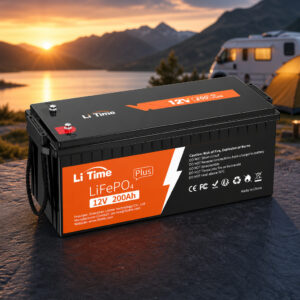
LiTime 12V 200Ah Plus LiFePO4 Lithium Battery
The LiTime 12V 200Ah Plus is a deep-cycle lithium iron phosphate battery for RV, marine, solar and off-grid power. It stores 2,560Wh and has a 200A built-in BMS. It’s meant as a house battery for steady loads, not for starting an engine.
This page contains affiliate links. We may earn a commission if you buy through them, at no extra cost to you.
Will This Battery Work in Your Setup?
A 12V LiFePO4 battery can replace a lead-acid house battery, but only when the rest of the system is ready for it. Run this quick check before you buy.
LiTime sells several 200Ah batteries, including Plus, self-heating and compact Bluetooth versions. Their size, features and ratings differ. Match the model name, label and manual of the unit you receive against the figures on this page.
LiTime 12V 200Ah Plus Specifications
| Property | Detail |
|---|---|
| Brand / model | LiTime 12V 200Ah Plus LiFePO4 Lithium Battery (200A BMS) |
| Chemistry | Lithium iron phosphate (LiFePO4), prismatic cells, rechargeable, deep-cycle |
| Nominal voltage | 12.8 V |
| Rated capacity | 200 Ah |
| Nominal energy | 2,560 Wh (2.56 kWh) |
| Built-in BMS | 200 A |
| Max continuous charge | 200 A (published maximum, not the recommended rate) |
| Max continuous discharge | 200 A |
| Published max output | 2,560 W (battery rating, not guaranteed AC output) |
| Short-term discharge | 400 A for 5 seconds. One-second rating: 600 A on LiTime’s US page, 800 A on LiTime’s business site and one manual copy |
| Charging method | CC/CV, 14.4 V ±0.2 V |
| Recommended charge current | 40 A (0.2C) |
| Charging temperature | 0°C to 50°C (32°F to 122°F) |
| Discharging temperature | −20°C to 60°C (−4°F to 140°F) |
| Storage temperature | −10°C to 50°C (14°F to 122°F) |
| Low-temperature protection | Listed on the US page, shown as N/A on the Australian page. Confirm for your unit |
| Internal resistance | ≤40 mΩ (manufacturer figure) |
| Dimensions | Approx. 532 × 207 × 215 mm (about 21 × 8.2 × 8.5 in); one LiTime page lists 216 mm height |
| Weight | About 20.6 kg (45.59 lb) in spec tables; some LiTime text says 48 lb or 21.7 kg |
| Case / rating | ABS housing, IP65 (not submersible) |
| Terminals | M8 bolts |
| Bluetooth / self-heating | Not included on the standard Plus |
| Expansion | Up to 4 in parallel and 4 in series (4P4S) |
| Cycle life (LiTime claim) | 4,000 cycles at 100% DoD, 6,000 at 80%, 15,000 at 60% |
| Warranty | 5 years, subject to LiTime terms |
| Listed compliance | FCC, CE, RoHS, UN38.3 (manufacturer-listed) |
Figures are LiTime’s published ratings, not independent test results. Weight, surge current and low-temperature protection are listed differently across LiTime’s pages. Check the label and manual supplied with your battery.
Battery Replacement Difficulty
Swapping like for like in a system that already uses lithium is a moderate job for a careful DIYer. Moving from lead-acid adds charger and wiring checks. Alternator charging, multi-battery banks and fixed home backup are harder and are often left to a qualified installer. Tap a slice to highlight it.
- 25% Handling weight & fit
- 25% Cabling & protection
- 35% Charger & system compatibility
- 15% Power-up checks
Difficulty score and effort split are an editorial estimate, not an official LiTime rating. This assessment covers swapping the whole battery only; opening the case or changing internal parts is not covered.
How to Replace Your Battery
A general guide for a conventional negative-ground 12V system. Follow your equipment manuals where they differ. Tap each step to tick it off as you go.
- 1Check fit and charging gearConfirm 12V system voltage, measure the space, and make sure every charging source can use a LiFePO4 profile.
- 2Isolate all powerSwitch off loads and the inverter, then disconnect shore power, solar, generator and alternator charging. Open the battery disconnect.
- 3Remove the old batteryPhotograph and label the wiring. Disconnect the negative cable first, then the positive, insulate the loose ends and lift the battery out.
- 4Mount and connect the new batterySecure it in the tray, then connect positive through suitable circuit protection and connect negative. Tighten the M8 terminals to the torque in your manual and fit terminal covers.
- 5Set the charge sourcesSet the charger, solar controller or DC-DC charger to LiFePO4 within LiTime’s 14.2V to 14.6V range, and keep charging between 0°C and 50°C.
- 6Power up and testCheck polarity and voltage, start with a small load, then build up. Look for loose connections, voltage drop or unusual heat.
The BMS may have tripped. Remove the load, check connections and temperature, and review the charge state. Never bypass the BMS. For large inverters, follow the inverter maker’s pre-charge advice.
What Else Can This Battery Power?
LiTime markets the Plus for RV, marine, solar and off-grid use. Check each device’s voltage, running current and start-up surge first.
- RV house powerLighting, pumps, fans
- Camper conversionsReplace lead-acid banks
- 12V fridgesCheck daily energy use
- DC-DC charged setupsAlternator charging
- Boat house loadsNot for engine starting
- Trolling motors30–70 lb thrust class
- Marine electronicsCheck device ratings
- Solar storageNeeds a charge controller
- Off-grid cabinsBattery banks
- Home backupWith a suitable inverter
- AC appliancesVia a rated inverter
- Series banksUp to four in series, matched
Safety, Storage & Disposal
LiTime states this battery is not for starting engines. Do not open, crush, short-circuit or burn it, and keep metal tools off the terminals. A high-current battery can cause burns or fire if a terminal is shorted.
- Charge only with a LiFePO4-compatible source, within 0°C to 50°C.
- Fit suitable circuit protection and tighten terminals to the manual’s torque.
- IP65 covers dust and water jets, not immersion. Never submerge the battery.
- For long storage, LiTime advises roughly 50% charge, disconnected, with a recharge at least every three months.
- Do not bin it. Take old lithium batteries to a battery recycling or hazardous-waste point.
LiTime 12V 200Ah Plus: FAQ
How does the 200Ah Plus differ from the standard 200Ah model?
LiTime lists the Plus with a 200A BMS, while the standard 12V 200Ah model has a 100A BMS. Both are rated 200Ah and 2,560Wh. The Plus adds current capability rather than extra stored energy.
Does the LiTime 12V 200Ah Plus have Bluetooth or self-heating?
Not the standard Plus. LiTime sells separate 200Ah models with Bluetooth or self-heating. For tracking charge on the Plus, LiTime points owners to an external battery monitor with a shunt.
Can this battery start an engine?
No. LiTime states it is not for starting engines. It is built for steady, deep-cycle loads such as RV, marine house power and solar storage.
What charger does it need?
Use a charger or controller with a LiFePO4 profile. LiTime lists CC/CV charging at 14.4V ±0.2V (recommended range 14.2V to 14.6V) and advises 40A. LiTime estimates about five hours to full at 40A, depending on conditions.
Can it be charged in freezing weather?
LiTime’s charging range is 0°C to 50°C, and its US FAQ warns that charging below 0°C can damage the cells. Automatic low-temperature protection is shown on the US page but listed as N/A on the Australian page. Confirm it for your unit.
How long will it last?
LiTime advertises 4,000 cycles at 100% depth of discharge, with higher counts at shallower discharge, and lists a five-year warranty. Cycle figures are manufacturer claims, not a guaranteed lifespan.
Can I connect several batteries together?
Yes, within LiTime’s 4P4S limit of four in parallel and four in series. Use matched batteries and follow the manual’s charging, balancing and wiring steps.
How should I dispose of an old battery?
Do not put lithium batteries in household trash or kerbside recycling. Insulate the terminals and take the battery to a recycling or hazardous-waste service that accepts it.