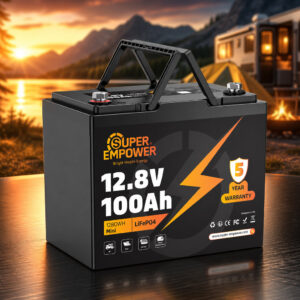
Deep Cycle Marine Battery 12V Trolling Motor: SUPER EMPOWER 12100-70L
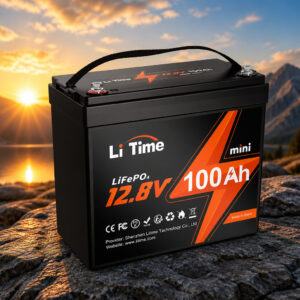
The SUPER EMPOWER 12100-70L is a rechargeable 12.8V LiFePO₄ deep-cycle battery rated at 100Ah and 1,280Wh. A built-in 100A battery management system guards the cells, and the manufacturer markets it for trolling motors, boats, RVs and solar storage.
This page contains affiliate links. We may earn a commission if you buy through them, at no extra cost to you.
Will This Battery Work With Your Trolling Motor?
Thrust rating alone does not tell you. Voltage, motor guidance, size and charging all matter. Run this quick check before you order.
Minn Kota’s manual says its motors were designed for lead-acid batteries and warns against running above 85% speed for long periods on lithium. Other brands set their own rules. Read your motor manual, and treat this battery as deep-cycle only, since no cranking rating is published.
SUPER EMPOWER 12100-70L Specifications
| Property | Detail |
|---|---|
| Brand / model | SUPER EMPOWER 12100-70L (MINI 100Ah) |
| Chemistry | Lithium iron phosphate (LiFePO₄), rechargeable |
| Nominal voltage | 12.8 V |
| Rated capacity | 100 Ah |
| Nominal energy | 1,280 Wh |
| Battery management system | Built-in, 100 A |
| Max continuous discharge | 100 A |
| Max continuous output power | 1,280 W |
| Recommended charge current | 20 A (0.2C) |
| Charging method | CC/CV; end-of-charge voltage 14.6 V (product page: 14.4 ± 0.2 V) |
| Internal resistance | ≤40 mΩ |
| Cycle life (manual) | 4,000 cycles to ≥80% capacity retention |
| Dimensions (manual) | 260 × 168 × 215 mm (10.24 × 6.61 × 8.46 in) |
| Weight | 22.4 lb per distributor listing; not stated in the manual |
| Size class | Marketed as BCI Group 24 |
| Terminals | M8 × 1.25 mm thread; M8 bolts, 5/8 in (16 mm) long |
| Housing / protection rating | ABS flame-retardant plastic; IP65 |
| Charging temperature | 0°C to 55°C (32°F to 131°F) |
| Discharging temperature | −20°C to 55°C (−4°F to 131°F) |
| Long-term storage | About 30–50% charge, dry and ventilated, away from heat; recharge roughly every six months |
| Low-temperature cutoff | Advertised; exact trip and restart points not given in the sources reviewed |
| Peak / surge current | Not listed in the sources reviewed |
| Expansion | Up to 4 in series and 4 in parallel; identical batteries bought within one month |
| Cranking rating | None published; built for deep-cycle use |
Values come from the 12100-70L installation and operation manual unless noted. Confirm the size and weight on your actual unit before fitting a tight compartment.
Trolling Motor Battery Replacement Difficulty
Swapping in a like-for-like lithium battery is a light job. Moving from a lead-acid battery to this one is moderate, because the charger, motor limits, wiring protection and fit all need checking. Banks, alternator charging or rewiring push it higher and call for a qualified installer. Tap a slice to highlight it.
- 20% Fit & mounting
- 20% Removing & swapping
- 35% Compatibility checks
- 25% Wiring, protection & first charge
The 4/10 score and the effort split are an editorial estimate for a lead-acid to LiFePO₄ swap in a single-battery setup, not an official rating. No manufacturer install-time figure exists.
How to Replace Your Trolling Motor Battery
Tap each step to tick it off as you go. This covers a basic single-battery setup. Follow the safety precautions in the manual, and hire a qualified marine installer if you are unsure.
- 1Confirm the matchCheck motor voltage, the motor maker’s lithium guidance, charger type and compartment size before touching any cable.
- 2Power down and isolateSwitch off the motor and all loads, turn the battery switch to OFF if fitted, and disconnect every charging source.
- 3Disconnect the old batteryPhotograph and label the wiring first. Remove the negative cable, then the positive cable, and keep the loose ends from touching.
- 4Remove and inspectRelease the hold-down, lift out the old battery, and check the tray, cables, lugs and restraint for damage or corrosion.
- 5Set the new batteryPlace it on a flat tray and secure it so it cannot shift. Keep metal tools and objects away from both terminals.
- 6Connect the cablesConfirm polarity on the terminals, attach positive first and then negative, and screw the post bolts in tightly. Loose terminals build up heat. Fit the insulating covers.
- 7Charge and testCharge with a LiFePO₄ charger from 0°C to 55°C, confirm the fuse or breaker is in place, then test the motor as its own manual directs.
The BMS may have shut the battery off for protection. The manual has an activation procedure for this case. Follow it or contact SUPER EMPOWER support, and never open the case.
Other Devices That Can Use This Battery
The manufacturer lists outdoor recreation, backup power and off-grid systems as uses, and its product page names boats, RVs, vans and solar storage. Check each device’s voltage and current draw before you connect it.
- Trolling motors12V systems only; check motor guidance
- Fish findersMarine electronics on fused 12V wiring
- Boat lightingCourtesy and navigation circuits
- Auxiliary boat circuitsDeep-cycle loads, not engine cranking
- RV lights and fans12V house loads
- RV water pumpsCheck pump amp draw
- Van and camper DC gearNeeds a LiFePO₄-ready charger
- Solar storageCharge through a solar controller
- Off-grid DC loadsMatch voltage and current
- Backup power systemsNeeds external charging gear
- Inverter-fed AC loadsExternal inverter required
Safety, Storage & Disposal
If the case is cracked, swollen, leaking, unusually hot or smells odd, stop using the battery and contact qualified support.
- Keep it away from water and never immerse it.
- Keep metal objects from touching both terminals at once.
- Charge only with a LiFePO₄ charger, from 0°C to 55°C.
- Store it at about 30–50% charge in a dry, ventilated spot away from heat.
- Build banks only from identical batteries of the same brand.
- Do not put it in household waste; recycle it under local rules.
SUPER EMPOWER 12100-70L: FAQ
What is the SUPER EMPOWER 12100-70L?
It is a rechargeable 12.8V, 100Ah, 1,280Wh LiFePO₄ deep-cycle battery in the MINI 100Ah family, with a built-in 100A battery management system.
Is it a deep cycle marine battery for a 12V trolling motor?
The manufacturer markets it for trolling motors, boats and other auxiliary power. It fits a 12V trolling motor only when the motor’s voltage, current draw and lithium guidance all match.
Can it start an outboard engine?
It is built for deep-cycle use and no cranking rating is published, which means you should not use it to start an engine.
Can one battery run a 24V or 36V trolling motor?
No. One battery gives 12.8V nominal. Higher-voltage motors need matched batteries wired in series, following the manufacturer’s bank rules.
Does thrust tell me if it works with my motor?
No. Thrust does not set system voltage. Minn Kota lists some 45 lb and 55 lb motors at 12V and 70 lb motors at 24V, for example. Check your exact motor manual.
Can I run my motor at full speed on lithium?
Check the motor maker’s rule. Minn Kota’s manual says its motors were designed for lead-acid batteries and warns that running above 85% speed for a long time on lithium could cause permanent damage. Its QUEST series is optimized for LiFePO₄.
How long will it run my trolling motor?
Runtime depends on average current draw, temperature, age and other loads. As a rough ideal, 100Ah divided by the average amps gives the hours. A steady 20A draw works out to about 5 hours, and real results will be lower.
What charger does it need?
A LiFePO₄ charger. The manual lists 20A as the recommended charge current and 14.6V as the end-of-charge voltage; the manufacturer’s product page gives a charging voltage of 14.4 ± 0.2V.
How long does charging take?
The manufacturer’s product page claims 1–2.5 hours, but gives no test conditions. At the recommended 20A, 100Ah works out to roughly 5 hours from empty by simple arithmetic. Charger output, starting charge and temperature all change the time.
Can it charge in freezing weather?
The manual sets charging at 0°C (32°F) and above, and discharging down to −20°C (−4°F). The manufacturer advertises a low-temperature cutoff, but no self-heating feature is documented.
Is it waterproof?
The manual lists IP65, but it also says not to immerse the battery and to keep it away from water. Install it in a protected spot.
How many cycles will it last?
The manual states 4,000 cycles to at least 80% capacity. Higher figures on the manufacturer’s product page, such as 15,000 cycles at 60% depth of discharge, are manufacturer claims tied to shallow discharge.
Can solar panels charge it?
Yes, through a solar charge controller compatible with 12V LiFePO₄. The manual says never to connect panels directly to the battery.
Can the boat’s alternator charge it?
The manual allows alternator or generator charging. For a DC-output source, it calls for a DC-to-DC charger added ahead of the battery.
Does it have Bluetooth?
Not in the documentation reviewed. SUPER EMPOWER sells separate Bluetooth models, therefore do not assume it here.
How should I store it?
For long-term storage, the manual advises about 30–50% charge in a dry, ventilated place away from heat, sun and fire, with a recharge about every six months.
What if it stops delivering power?
The BMS may have shut it off to protect the cells. The manual has an activation procedure for this case. Follow it or contact SUPER EMPOWER support. Never open the case.
Where can I get support?
The manual lists Service@super-empower.com. The brand site also gives hello@super-empower.com and (510) 891-1056.